

Category: CertFocus

Additional Insured vs. Named Insured: Complete Coverage Guide

Choosing between option a and b - opposite signs making choice between two options

News / Additional Insured vs. Named Insured: Complete Coverage Guide

Additional Insured vs. Named Insured: Complete Coverage Guide

Choosing between option a and b - opposite signs making choice between two options

Most contractors will hand you a certificate of insurance and claim you’re protected, but there’s a huge difference between being named insured, additional insured, or just a certificate holder. Named insured owns the policy and pays the premium, while additional insured gets coverage extended to it without paying a premium. Those with certificate holders only status get a piece of paper and zero protection against third-party liability.

The distinction matters because when contractors cause accidents and people get hurt, additional insured gets legal defense and claim payments, while certificate holders have to hire their own legal counsel and pay to defend claims resulting from activities of subcontractors, suppliers and vendors. The average construction dispute value globally reached $52.6 million in 2021, showing just how expensive this litigation can be.

CertFocus by Vertikal RMS automatically reviews COIs and required endorsements to confirm you have actual additional insured coverage instead of just worthless conditional language that has no value when you need it most.

What’s the Difference Between Additional Insured and Named Insured?

The named insured owns the insurance policy, while the additional insured gets coverage extended to it under the named insured’s policy. The named insured acquires the policy and pays for it, while the additional insured gets added to the policy later to extend the protection offered by the policy. The additional insured does not own or have any control over the policy.

Named insured parties have the authority to cancel the policy, change coverage limits, and make modifications, while additional insureds have no such authority.

Named Insured Definition and Rights

Named insured is the person or company that owns the insurance policy and is identified on the declaration page of the policy form. When you buy insurance, you become the named insured. This gives you complete control over everything about the policy, including:

  • Coverage amounts
  • What’s covered
  • Who gets added
  • When to cancel

You also get all the responsibilities that come with owning the policy. You pay all the premium and make all the decisions about coverage. If multiple people are named insureds on the same policy, then the first person listed usually gets the most authority over managing everything. You have direct communication rights with the insurance company and can contact them with questions about claims or coverage.

Additional Insured Definition and Protection

Additional insured gets extended coverage under someone else’s insurance policy without paying premiums or controlling the policy. You get added through special paperwork added to the named insured’s policy, called endorsements. The additional insured endorsement spells out exactly what protection you get and when you get it. This coverage usually only applies when claims come from the named insured’s work that involves your business.

You don’t pay any premium for getting additional insured protection, but you also don’t get to make any decisions about the policy. You can’t change coverage amounts or control how claims get handled. But the good news is that additional insureds get full defense coverage and can receive claim payments just as if they owned the policy themselves when covered incidents happen. Most business contracts require contractors to add you as an additional insured because it transfers their liability risks to their insurance carrier instead of you and your carrier.

Is a Certificate Holder the Same as an Additional Insured?

Certificate holder and additional insured are completely different things with different protection levels. These certificate of insurance basics determine whether you get actual coverage or just the evidence of coverage in the form of the COI. Being a certificate holder means someone gave you a copy of their insurance certificate, which is basically a piece of paper showing they have insurance. Being an additional insured means you’re actually covered under their policy and can file claims when a loss occurs.

The most important difference to keep in mind is that certificate holders get zero protection from the insurance policy. You’re just holding a document that proves someone else has coverage. This is huge when accidents happens and a loss occurs.

For example, let’s say a contractor’s faulty electrical work causes a fire that injures a customer in your building. The injured customer sues both you and the contractor for damages. If you’re just the certificate holder, then you have to defend the claim yourself with your own insurance coverage and lawyers. The contractor’s insurance will protect them, but they have no obligation to you. However, if you’re an additional insured on the contractor’s policy, their insurance will defend you in that lawsuit and pay any settlements or judgments against you.

What You Get Certificate Holder Additional Insured
Insurance Coverage None, but confirms the contractor has coverage Full liability coverage
Can File Claims No Yes
Legal Defense None provided Insurance defends you
Costs You Money No Cost No Cost
Protection When Contractor Causes Damage No, the contractor’s insurance only covers the contractor for the damage caused by them Yes, plus you get covered for defense costs if sued over their work
When Third Parties Sue You You defend yourself The contractor’s insurance defends you
Contract Value Confirms the contractor has protection Confirms the contractor has protection plus extends coverage to you
What It Really Means You know they have coverage to support their agreement to provide indemnity in the event of damage caused by them You’re covered by their insurance when lawsuits involve damage caused by them

What Does It Mean if I’m an Additional Insured on Someone’s Insurance Policy?

Being additional insured means you get extended liability coverage under someone else’s insurance policy without paying for it or owning the policy. You essentially become a beneficiary of their insurance when claims arise from their work or operations involving your business. This coverage kicks in when third parties sue you for incidents related to the policyholder’s activities.

The coverage scope usually includes defense costs and claim payments when lawsuits name both you and the policyholder for the same incident. For example, if a contractor’s work causes an accident and an injured party sues both of you, the contractor’s insurance defends and covers you as additional insured. However, this protection only applies to claims arising from the contractor’s work, not your own separate business activities.

You gain the right to file claims directly with their insurance company when incidents happen. You don’t have to wait for the policyholder to deal with things, as you can just contact the insurer directly and demand defense coverage when lawsuits hit. The insurance company has the same duty to defend you as it does its own policyholders for qualifying claims.

This protection saves you from using your own insurance for contractor-related incidents, especially if you also have primary and noncontributory coverage. If a contractor causes $500,000 in damage that leads to lawsuits against you, their insurance handles everything instead of your policy taking the hit. U.S. commercial liability costs totaled $347 billion in 2021, with small businesses bearing almost 50% of these costs despite representing a smaller portion of the economy, according to a study from the U.S. Chamber of Commerce Institute for Legal Reform. That makes it hard to overstate how important it is to have adequate protection.

Certificate Holder vs. Additional Insured: When You Need Each

Figuring out whether you need certificate holder or additional insured status depends on how risky the work is and how much trouble you could get into if something goes wrong. For simple, low-risk jobs, a certificate of insurance is usually good enough. For risky work that could get you sued, you’ll want additional insured protection so your contractor’s insurance covers you, too.

Think of it this way: if a contractor is just delivering products to your office, then certificate holder status works fine. If they’re doing construction work where someone could get hurt, then being added as an additional insured on the contractor’s general liability insurance policy can help you avoid getting hit with lawsuits. Just an average slip and fall claim costs $20,000, with some bodily injury claims reaching astronomical amounts that could devastate contractors and your business without proper coverage.

When To Request Certificate Holder Status

Certificate holder status works great for low-risk jobs where you mainly just want proof that the contractor has insurance. This covers things like office cleaning or basic maintenance, where not much can go wrong. You get a document showing they have coverage, which fulfills your contractual requirements and gives you peace of mind.

You’ll also use certificate holder status for routine business relationships where the contract says you need insurance proof, but the work isn’t that risky. Professional services, consultants, and suppliers tend to fall into this category as it relates to general liability insurance. Their work doesn’t create much risk for your business for bodily injury or property damage, so you just need to know they can handle their own problems.

When To Require Additional Insured Status

You need additional insured protection when contractor work is risky enough that you could get sued alongside them. Construction projects and anything involving heavy equipment or lots of people around definitely need additional insured coverage. When contractors working at your organization do things that could hurt someone, you want their insurance to protect you from lawsuits.

You should also demand additional insured status when your contractor insurance requirements make you responsible for what they do, or when local rules require it. Big commercial projects or government contracts usually fall here. This protection keeps contractor problems from impacting your insurance costs and gives you direct help with defense costs when lawsuits arise.

How Do I Know if I Should Be Additional Insured or Just Certificate Holder?

Choosing between certificate holder and additional insured status starts with honestly assessing how much risk the contractor’s work creates for your business. Look at what could go wrong and who might get sued if it does. High-risk activities like construction or anything involving heavy equipment almost always justify additional insured requirements. Low-risk work like consulting or basic office services is usually okay with just certificate holder verification.

Use this framework to decide whether you need certificate holder or additional insured status based on your specific situation and risk level. The higher the risk and complexity, the more you need additional insured protection instead of just certificate holder status.

Situation Certificate Holder Additional Insured
Where They Work Away from your place or quick visits Performed primarily at your location
How Risky Safe office work or consulting Construction or dangerous equipment
Contract Size Under $50,000 or routine work Over $50,000 or complex projects
Public Around Few people around Lots of customers or visitors
Equipment Used Basic, low-risk equipment Heavy machinery or hazardous materials
How Long Quick jobs or one-time work Long-term relationships
Extra Cost No cost to the contractor Potentially a small fee for the contractor
Your Protection See evidence that the contractor has coverage Get covered by the contractor’s insurance when you’re sued

Understanding Different Types of Named Insured

Not all named insured parties get the same rights and responsibilities under insurance policies. You might have multiple people listed as named insured on the same policy, but they don’t all get the same level of control. Some get more authority than others, and some get added later with different privileges than the original policyholder.

First Named Insured vs. Secondary Named Insured

First named insured is the person listed first on the policy who gets the most control and responsibility. This person is usually the one who bought the policy and pays the premiums. They get all the renewal notices and have direct authority to communicate with the insurance company. The first named insured also receives notice of cancellation when the insurance company elects to cancel the policy.

Secondary named insurance gets the same coverage protection but with less control over policy management. They can usually make some changes to the policy and receive coverage benefits, but the first named insured holds primary responsibility for major decisions. If you and your business partner both own a company, you might both be named insured, but whoever is listed first typically handles the insurance decisions.

Additional Named Insured vs. Additional Insured

Additional named insureds enjoy full policy rights and can make changes to coverage, while additional insureds only get protection without policy control. Additional named insured parties can modify the policy, receive all policy correspondence, and share responsibility for premium payments. They’re essentially co-owners of the policy.

Additional insureds just get protection when incidents happen, but they can’t change anything about the policy. They can’t cancel coverage or make decisions about claims. Additional named insurance is like being a co-owner of a car, while additional insured is like getting permission to drive it, but not being able to sell it. Your contracts should require that your company be added as an additional insured, not an additional named insured.

What Are the Risks of Adding Someone As an Additional Insured to My Policy?

Adding people or contractors as additional insureds to your policy creates a few risks that can cost you money and complicate your insurance coverage. While it helps your business relationships, it also means other companies can make claims against your insurance for incidents you didn’t cause. You need to understand what you’re getting into before you start adding contractors to your policy as additional insureds.

Here are the main problems you might run into when adding additional insured parties:

  • Your insurance gets more expensive: Insurance companies usually charge extra fees for each additional insured endorsement, typically between $25 and $150 per year per contractor. Most importantly, your insurance premiums will go up if any of these contractors make claims on your insurance policy.
  • Other companies’ problems become your problems: Additional insured contractors can file claims against your policy even when you had nothing to do with what went wrong. Their bad safety habits or risky business decisions could end up causing your insurance carrier to spend time and money investigating claims and could result in an increase in your insurance premiums.
  • Everything gets more complicated: When multiple companies have coverage under different policies, it can be difficult to figure out who pays for what. Insurance companies might fight about which policy should handle a claim, which slows everything down and creates legal headaches nobody wants.
  • More paperwork and tracking headaches: You have to keep track of all these endorsements, confirm they stay current, and update them when contracts change. CertFocus by Vertikal RMS automates this tracking by monitoring all your additional insured requirements and sending alerts when endorsements are deficient or need updates.

Additional Insured Coverage by Insurance Type

Not all insurance types offer additional insured protection in the same way, and some don’t offer it at all. General liability insurance provides the most common additional insured coverage that most contractors use. Professional liability and workers’ compensation have different rules and limitations that affect when and how you can get additional insured status.

Additional Insured on General Liability Insurance

General liability insurance provides the most straightforward additional insured coverage that protects you from third-party lawsuits related to the contractor’s work. And this protection is not particularly expensive, as contractors pay an average of $82–142 for agents or brokers to issue additional insured endorsements for general liability insurance, with 61% of construction businesses paying less than $100 per endorsement, according to Insureon.

This coverage kicks in when someone gets injured or property gets damaged because of the contractor’s activities, and they sue both you and the contractor. The contractor’s general liability insurance will defend you and pay settlements or judgments when you’re named in these lawsuits.

Furthermore, there are different types of general liability additional insured endorsements that provide varying levels of protection:

  • CG 20 10 (Ongoing Operations): Covers you only while the contractor is actively performing work, but protection ends when the job is complete.
  • CG 20 37 (Completed Operations): Protects you after the contractor finishes their work, covering claims that arise from defects or problems discovered later.
  • CG 20 33 (Ongoing and Completed Operations): Provides the broadest protection by covering you both during the work and after completion.

Additional Insured on Professional Liability and E&O Insurance

Professional liability and errors and omissions insurance almost never offer additional insured coverage because these policies protect against professional mistakes rather than general accidents. When additional insured coverage is available on professional liability policies, it usually only applies to very specific situations where you might get sued for the professional’s advice or services. Most professional liability policies exclude additional insured coverage entirely.

Industries like architecture, engineering, and consulting sometimes provide limited additional insured coverage for clients, but the protection is much narrower than that of additional insured status on general liability coverage. The coverage usually only applies when you get sued specifically for the professional’s errors or omissions in their work for you.

Additional Insured on Workers’ Compensation

Workers’ compensation insurance traditionally doesn’t offer additional insured coverage because it’s designed to cover the policyholder’s own employees, not outside parties. However, some states allow limited additional insured coverage on workers’ compensation policies when you might be held responsible for injuries to the contractor’s employees. This coverage protects you when injured workers sue you directly instead of just filing workers’ compensation claims.

Additional Insured vs. Additional Interest: Key Differences

Additional insureds get actual liability coverage under someone else’s policy, while additional interest just gets notified about policy changes without any coverage benefits. You want additional insured status when you need protection from lawsuits, but additional interest works fine when you just need to know if someone’s insurance gets canceled.

These are the main differences between additional insured and additional interest:

Aspect Additional Insured Additional Interest
Coverage Provided Full liability protection No coverage at all
Claims Rights Can file claims and get defense Cannot file claims
Notifications May receive policy change notices Always receives policy notices
Cost to Policyholder Small endorsement fee Usually free
Protection Level Substantial lawsuit protection Only notification rights
Common Users Contractors, lessees, business partners Lenders, landlords, equipment owners
Purpose Transfer liability risk Monitor policy status

Common Additional Insured Mistakes To Avoid

Many businesses think they have additional insured protection when they actually don’t because of common mistakes in how endorsements get set up or verified. These errors can go unnoticed until after claims happen, which would leave companies exposed to lawsuits they thought were covered. Construction defect litigation is expected to rise in 2025 due to the ongoing skilled labor shortages, according to a Seyfarth Shaw report, so it pays to be well-protected.

Avoid these mistakes when confirming you have additional insurance status:

  • Accepting vague blanket wording: Generic certificate language like “additional insured as required by contract” provides no actual protection because it doesn’t confirm specific endorsements exist on the policy. In some instances, reliance on additional insured status by a blanket policy endorsement is deemed acceptable to alleviate the amount of effort required for validating coverage
  • Missing coverage for completed operations: Many additional insured endorsements only cover ongoing work, leaving you unprotected from claims that arise after the contractor finishes the project.
  • Wrong endorsement timing: Adding additional insured status after work begins or claims are made provides no protection because endorsements only cover incidents that happen after the additional insured status has been established.
  • Failing to verify endorsement existence: Certificates can show additional insured status without the actual endorsement being added to the policy, creating a false sense of security.
  • Incorrect certificate holder information: Small errors in company names or addresses on endorsements can void protection when claims are filed.
  • Assuming all policies include additional insured: Some insurance types like professional liability rarely offer additional insured coverage, but contractors might not realize this limitation.

Additional Insured Wording on Certificate of Insurance

Certificate descriptions must contain specific additional insured language that confirms that actual endorsements exist on the policy rather than just indicating potential coverage. Vague or conditional language creates dangerous coverage gaps that leave you unprotected when claims happen. Verify the following language when reviewing your additional insured coverage:

  • Proper additional insured language: Look for specific statements like “Additional Insured per endorsement” or “Additional Insured as respects operations performed for the certificate holder” that confirm active coverage. Many contracts also include waiver of subrogation requirements alongside additional insured status.
  • Required certificate elements: Verify that additional insured language names your company specifically and references the coverage types where endorsements apply.
  • Dangerous conditional language: Avoid certificates stating “additional insured if required by contract” or “additional insured may apply” because these phrases indicate that the endorsements might not actually exist.
  • Coverage scope verification: Check that descriptions specify whether protection applies to ongoing operations, completed operations, or both types of coverage.
  • Endorsement from references: The best certificates include specific endorsement form numbers like “CG 20 10” or “CG 20 37” that confirm exactly which additional insured coverage applies.

What Are Insurance Endorsements and How Do They Work?

Insurance endorsements are the actual documents that modify policy terms and create the coverage changes certificates claim to show. Certificates summarize what coverage exists, but endorsements are the formal amendments that actually add or remove protection. Without proper endorsements attached to the policy, certificate notations about additional insured status or waivers of subrogation provide zero enforceable rights when claims occur.

Insurance Endorsement Definition

An insurance endorsement is a written amendment to an insurance policy that changes the policy’s terms, coverage, or beneficiaries. These documents get called “riders” or “policy amendments” and become permanent parts of the insurance contract once added.

It’s what actually implements coverage changes rather than just describing them. When a certificate states “Additional Insured per endorsement,” the endorsement form like CG 20 10 or CG 20 37 creates the actual coverage. The certificate just confirms this endorsement exists.

Insurance policy endorsements override standard policy language when conflicts pop up. This means endorsements can override exclusions, add new coverage, or restrict protections that would otherwise apply under the standard policy. Endorsements become part of the insurance contract once issued by the insurance company and are listed on or attached to the policy documentation.

Common Types of Insurance Endorsements

Different endorsements serve specific purposes in modifying commercial insurance policies:

  • Additional insured endorsements: Forms like CG 20 10, CG 20 37, and CG 20 33 extend the named insured’s liability coverage to third parties for claims arising from the policyholder’s work. CG 20 10 covers ongoing operations only, CG 20 37 provides completed operations protection, and CG 20 33 provides blanket coverage for ongoing operations, automatically adding anyone required by written contract. These endorsements spell out exactly when and how the additional insured gets protected.
  • Waiver of subrogation endorsements: Stop the insurance company from pursuing the party named in the waiver after paying claims. For example, if a contractor damages your property and your property insurer pays you, your insurer normally could sue the contractor to recover what they paid. A waiver of subrogation endorsement gives up that right, protecting the contractor from being sued by your insurer.
  • Primary and non-contributory endorsements: Designate which insurance policy pays claims first when multiple policies could respond to the same loss. Primary endorsements make the policy respond before other available insurance, while non-contributory provisions prevent the insurer from seeking contribution from other policies. These stop coverage disputes between multiple insurance companies.
  • Blanket additional insured endorsements: Automatically add as additional insureds anyone the named insured agrees to add through written contracts, without requiring separate endorsements naming each party. Forms like CG 20 33 and CG 20 38 provide blanket coverage, though both cover ongoing operations only. Completed operations still requires a CG 20 37.
  • Hired and non-owned auto endorsements: Extend commercial auto liability coverage to vehicles the business doesn’t own but uses for work, including employee personal vehicles or rental cars. This fills gaps when standard auto policies don’t cover these situations.

How Endorsements Modify Insurance Policies

Endorsements change policies by adding coverage, removing coverage, or clarifying how existing terms apply to specific situations. When an endorsement contradicts standard policy language, the endorsement wins because it represents the specific agreement between the insured and insurer.

Adding an additional insured endorsement extends liability coverage to third parties who aren’t named on the policy. The base commercial general liability policy only covers the named insured. The CG 20 10 endorsement amends the “Who Is An Insured” section to include additional parties, but only for liability from the named insured’s ongoing operations performed for those additional insureds.

Endorsements removing coverage work by adding exclusions or restrictions to standard policy grants. A total pollution exclusion endorsement removes coverage for pollution-related claims that might otherwise be covered. These restrictive endorsements often show up on policies for high-risk industries where insurers want to limit specific exposures.

Endorsements stick with policies through renewal periods unless specifically removed by the insurance company or requested by the policyholder. When policies renew annually, endorsements typically carry forward automatically. However, insurance companies can remove or modify endorsements at renewal, which is why annual verification of required endorsements matters.

Why Certificate Notations Don’t Replace Actual Endorsements

Certificates of insurance display summary information about policies but create no enforceable coverage rights. The standard ACORD certificate disclaimer explicitly states: “This certificate is issued as a matter of information only and confers no rights upon the certificate holder. This certificate does not affirmatively or negatively amend, extend or alter the coverage afforded by the policies below.”

Certificate notations claiming “Additional Insured per contract” or “Waiver of Subrogation as required by written contract” mean nothing without actual endorsement forms attached to the underlying policy. Insurance companies have no obligation to honor these certificate notations if the endorsements don’t actually exist.

Here’s how this creates problems:

A general contractor receives a certificate from a subcontractor showing “Additional Insured – CG 20 10 and CG 20 37.” The certificate appears to confirm complete additional insured protection for both ongoing and completed operations. Six months after the subcontractor finishes work, defects cause property damage. The injured property owner sues both the general contractor and the subcontractor.

The general contractor files a claim as an additional insured on the subcontractor’s policy. The insurance company investigates and discovers only a CG 20 10 endorsement exists on the actual policy. No CG 20 37 completed operations endorsement was ever added, despite what the certificate stated. The insurance company denies the general contractor’s claim because the work finished six months ago, and CG 20 10 only covers ongoing operations.

The general contractor assumed they had protection based on the certificate notation, but the missing endorsement left them exposed. The certificate’s disclaimer protects the insurance company from liability for the incorrect information.

Proper verification requires requesting copies of actual endorsement forms, not just certificates claiming endorsements exist. COI endorsement verification should include reviewing the policy declarations page showing all attached endorsements and confirming the endorsement form numbers match what contracts require.

How CertFocus by Vertikal RMS Manages Additional Insured Verification

CertFocus by Vertikal RMS automates the complex process of verifying additional insured status across all your contractor relationships through AI-powered certificate analysis and continuous compliance monitoring. The platform eliminates the need to manually review certificates by automatically detecting additional insured language, verifying endorsement accuracy, and tracking compliance requirements across different insurance coverage types.

This level of automation and precision reflects Vertikal RMS’s commitment to customer success:


“Our customers know they can always count on us. At Vertikal RMS, we go the extra mile to make every interaction valuable, dependable, and centered on their success.”


— Rachel Crowe, Director of Customer Success, Vertikal RMS

Automated Additional Insured Detection

CertFocus by Vertikal RMS uses Hawk-I artificial intelligence to scan incoming certificates and identify additional insured language, flagging documents that lack required endorsements or contain vague wording. The AI system reads complex insurance terminology and recognizes valid additional insured provisions even when different insurance companies use varying language or formatting. This prevents false approvals or certificates that appear to show additional insured status without actual endorsement backing.

Compliance Tracking Across Insurance Types

CertFocus by Vertikal RMS monitors additional insured requirements across multiple insurance types simultaneously, confirming that contractors are providing complete protection rather than partial coverage. The system tracks general liability, auto liability, and other coverage types that require additional insured endorsements. This comprehensive monitoring prevents the common problem of assuming that complete coverage exists when only some policies include additional insured status.

The platform manages renewal tracking and expiration monitoring for all required coverages, sending automated alerts before coverage lapses. CertFocus by Vertikal RMS maintains detailed records of coverage effective dates and policy renewal cycles to prevent coverage gaps that could expose your business to liability risks.

Cost Impact of Additional Insured Endorsements

Some insurance companies charge anywhere from $25 to $150 per additional insured endorsement per year, with costs varying based on coverage types and risk levels. Professional liability and specialty coverages usually cost more for additional insured endorsements than standard general liability policies, but are rarely required. These fees represent a small fraction of total insurance costs but can add up when multiple contractors require endorsements.

The real cost comes from claims made by additional insured parties that affect your loss history and future premium rates. The administrative costs for managing multiple endorsements and verifying compliance can also take up a significant amount of time without automated systems. CertFocus by Vertikal RMS reduces these administrative costs by automating endorsement tracking and verification processes.

Frequently Asked Questions About Additional Insured Status

The Named Insured is the person or company that owns the insurance policy and appears first on the policy documents. They pay premiums, make coverage decisions, and have complete control over policy terms and modifications.

Yes, you can be an additional insured on multiple policies from different contractors or business partners. Each additional insured endorsement provides separate protections for activities related to that specific relationship or contract.

No, additional insureds don’t pay premiums for the coverage they receive. The named insured who owns the policy pays all premiums, including any endorsement fees for adding additional insured parties.

Additional insured coverage lasts as long as the endorsement remains active on the policy. Coverage usually ends when the underlying policy expires, gets canceled, or when the endorsement gets removed.

Yes, the named insured can cancel the additional insured endorsements during the policy period, though some states require advance notice. Endorsements also automatically cancel when the underlying policy expires or gets canceled.

Primary insured refers to coverage that pays first before other insurance policies apply. Secondary insured means the coverage only pays after other applicable insurance has been exhausted or when no other coverage exists.

Vendors should be additional insured when they need liability protection from their work activities, based on the vendor insurance specifications. Certificate holder status only provides proof that they have insurance without extending any coverage benefits to you.

No, certificate holders cannot file claims on the policy because they receive no coverage benefits. Only named insured and additional insured parties can file claims and receive coverage under insurance policies.

Additional interest means you receive policy notifications and cancellation notices but get no coverage benefits. This status helps monitor policy status without providing liability protection like additional insured coverage does.

Ready to Rise Above Risk?

Reach out to discover how Vertikal RMS can help your organization implement an efficient and effective COI compliance tracking system.


Ready to Rise Above Risk?

Unlock Powerful Synergy: How CertFocus & PreQual Integration Transforms Subcontractor Risk Management

CertFocus PreQual Synergy

News / Unlock Powerful Synergy: How CertFocus & PreQual Integration Transforms Subcontractor Risk Management

Unlock Powerful Synergy: How CertFocus & PreQual Integration Transforms Subcontractor Risk Management

CertFocus and PreQual Synergy V2

Managing subcontractor insurance and prequalification through separate systems creates duplicate work, missed steps, and compliance gaps that put your projects at risk. You enter the same vendor information twice, chase down certificates in one platform while managing prequalifications in another, and hope nothing falls through the cracks.

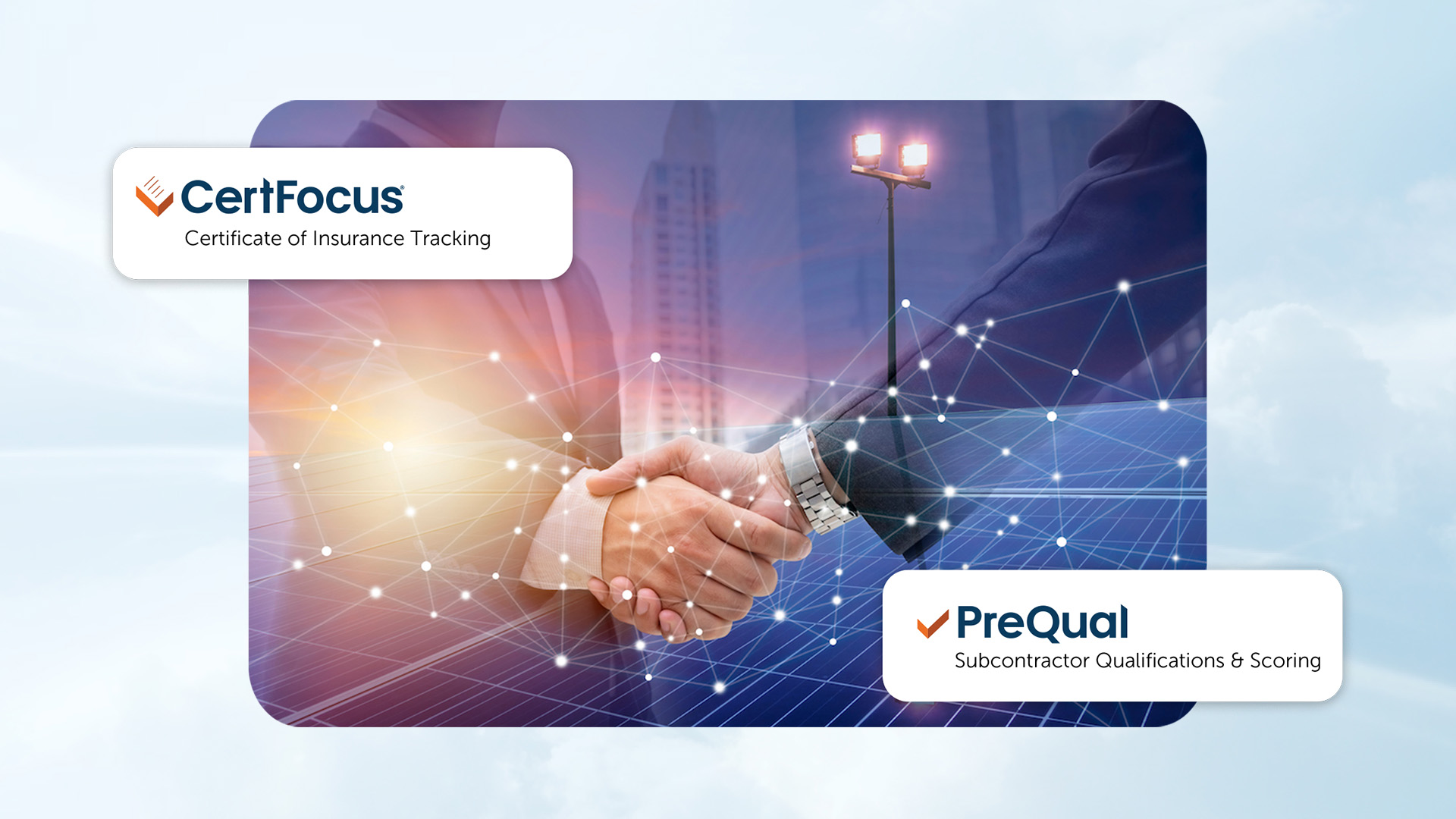
CertFocus by Vertikal RMS handles certificate of insurance tracking while PreQual manages subcontractor qualifications and scoring. The integration between these platforms eliminates duplicate data entry and keeps insurance compliance visible throughout your entire prequalification process.

Two Industry-Leading Solutions, One Unified Workflow

CertFocus tracks your certificate of insurance (COI) management while PreQual handles thorough subcontractor qualification and scoring. Together, they let you coordinate critical risk and compliance data without jumping between systems or losing track of requirements.

This integrated approach represents Vertikal RMS’s customer-first philosophy:


“At Vertikal RMS, we’ve built a culture centered on our customers—one where every decision is shaped by their success. By fostering this focus, we deliver not only excellent systems and services but also lasting value through solutions like CertFocus and PreQual.”


— Matt Kelly, President, Vertikal RMS

One-Click Integration: Fast-Track Subcontractor Approval

You don’t need separate systems for hiring and qualifying subs anymore. When your admin adds a new vendor to a project, they see a Send PreQual Request button. One click starts the vendor’s prequalification workflow in PreQual automatically.

Benefits at a Glance:

  • No duplicate data entry: Handle insurance validation and prequalification steps simultaneously.
  • Permission controls: Only users with executive or admin roles see the action, keeping things secure and clear.
  • Real-time feedback: Once a request is sent, it’s automatically logged, the UI updates to prevent duplicate requests, and your entire team knows the action has occurred. No confusion, no redundancy.
  • Track and audit: Every prequal request is logged with username, timestamp, and vendor info.
  • Single source of truth: All steps, statuses, and activities are logged and easily referenced.

Live Insurance Compliance in Your PreQual Scorecards

Once you initiate a subcontractor’s prequalification from CertFocus, their current COI compliance status appears directly on their PreQual scorecard.

Here’s how it elevates your process:

  • Instant COI visibility: As you review a sub’s PreQual scorecard, their current insurance compliance (from CertFocus by Vertikal RMS) is displayed front and center. No more switching platforms or wasting time searching.
  • Always up to date: Any changes to insurance status or compliance in CertFocus by Vertikal RMS are instantly reflected on the most current PreQual submission, ensuring risk assessment is always accurate.
  • Historical accuracy: If a new PreQual submission is made, old scorecards freeze the COI status at the time of submission for a clear audit trail.
  • Clear compliance labels: Insurance coverage is flagged as “Compliant” or “Non-Compliant” using simple definitions to boost decision-making clarity.
  • Automatic updates: If you ever need to roll back or delete a submission, the system automatically updates compliance status, keeping all records in sync.

Why Clients Love the CertFocus & PreQual Synergy

Those who’ve tried CertFocus by Vertikal RMS and PreQual love it. Here’s why:

Fewer errors, less manual work: No more redundant steps or mix-ups when moving from insurance validation to prequalification. Documents don’t get lost and communication gaps disappear.

Faster onboarding: New vendors are entered once, initiated for both insurance and qualification, with all necessary data carried along automatically.

Stronger risk defense: With all activities logged and status updates live, compliance managers and project managers can immediately spot non-compliance and fix it before risk escalates.

Empowered decision-making: Real-time, authoritative compliance data makes executive reviews fast, defensible, and audit-proof, for any project or vendor.

Vertikal RMS gives you powerful tools at reasonable prices:


“Meeting client needs takes more than technology—it takes balance. At Vertikal RMS, we align powerful systems with exceptional services, combined with a strong value proposition, so every client benefits from quality and affordability.”


— Lee Roth, Chief Revenue Officer, Vertikal RMS

This philosophy shows in bundle pricing that makes comprehensive vendor risk management affordable for contractors without enterprise budgets, with discounts applying when purchasing both platforms together.

Integrated Pricing: Save Money While Getting More Protection

Buying CertFocus by Vertikal RMS and PreQual by Vertikal RMS together costs less than purchasing separate insurance tracking and prequalification platforms from different vendors while avoiding integration problems altogether.

Combined Platform Pricing

Platform Service Level Starting Cost What It Covers
CertFocus by Vertikal RMS Self-Service $6–$8 per vendor/year ($7,500 min) Hawk-I AI verification, unlimited users, automated renewals
CertFocus Full-Service $13–$29 per vendor/year ($10,000 min) Credentialed professionals (CIC, CPCU, CISR, CRIS), expert reviews, dedicated support
PreQual Self-Service ~$6 per sub ($10,000 min) Automated scoring, document management, compliance tracking
PreQual Full-Service $30–$165 per prequalification ($10,000 min) Financial analysts, cash flow review, bankruptcy detection
Bundle Discount Both Platforms Contact for pricing Additional savings on combined purchase

Why Integrated Platforms Cost Less

Forcing competing products to communicate eats budget through API setup fees, ongoing maintenance costs, and the inevitable data sync failures that require staff time to fix manually. Companies putting together point solutions from different vendors spend tens of thousands per year on subscriptions and integration expenses.

CertFocus by Vertikal RMS and PreQual by Vertikal RMS talk to each other natively because the same company built both. No API issues, no duplicate vendor records across platforms, and no wondering why insurance status shows differently in your prequalification system versus your COI tracker.

Ready to Transform Your Compliance & Qualification Workflow?

CertFocus by Vertikal RMS and PreQual integration stops the administrative nightmare of managing subcontractor insurance and qualification through separate systems. You get complete vendor management without duplicate work, missed compliance steps, or gaps that expose your projects to liability risks.

Stop juggling multiple platforms and hoping nothing falls through the cracks. The integration handles insurance tracking and prequalification simultaneously, so you approve qualified vendors faster while maintaining bulletproof compliance records that protect your business.

Contact us for a demo or to learn how to enable the integration for your organization!

Frequently Asked Questions About CertFocus & PreQual Integration

Both platforms price independently based on vendor volume and service level, with bundle discounts available when purchasing together. CertFocus by Vertikal RMS starts at $6–$8 per vendor for self-service or $13–$29 for full-service. PreQual by Vertikal RMS runs $6 per sub for software-only or $30–$165 per prequalification with financial analysts.

Yes, CertFocus by Vertikal RMS offers vendor-pay at $85–$150 per vendor while PreQual by Vertikal RMS lets contractors set their own sub-pay rates. You can mix models, having vendors cover insurance tracking while you pay for prequalification or vice versa depending on budget priorities.

CertFocus by Vertikal RMS and PreQual by Vertikal RMS work independently but integrate for complete vendor risk management. Use CertFocus by Vertikal RMS alone for insurance tracking without financial analysis, or PreQual by Vertikal RMS alone for prequalification without ongoing COI monitoring. Most contractors need both to catch insurance and financial problems through connected systems.

Ready to Rise Above Risk?

Reach out to discover how Vertikal RMS can help your organization implement an efficient and effective COI compliance tracking system.
Ready to Rise Above Risk?

CertFocus by Vertikal RMS Advanced Reporting: Easy-to-Use Dashboard and Analytics

towfiqu barbhuiya nApaSgkzaxg unsplash

Actionable Data Through CertFocus by Vertikal RMS’s Easy-to-Use Reporting Dashboard

Your business connects to hundreds of technology platforms that feed your valuable business intelligence about your vendors, suppliers, and third-party contractors. You need systems that let more people in your organization access information assets no matter where they’re hosted.

CertFocus by Vertikal RMS now includes advanced reporting features that make certificate of insurance tracking and compliance management easier for your entire team. Export critical vendor information, generate dynamic ad-hoc reports, and visualize compliance gaps without technical expertise. Turn data into action instantly through CertFocus by Vertikal RMS’s intuitive reporting dashboard.

CertFocus by Vertikal RMS uses an API-led approach that connects to your existing technologies and required endpoints. The platform integrates with:

  • check mark icon Enterprise resource planning (ERP) systems

  • check mark icon Risk management information systems (RMIS)
  • check mark icon Accounts payable (A/P)
  • check mark icon Contract management software
  • check mark icon Other business systems through open APIs that make hundreds of connections seamlessly


Why CertFocus by Vertikal RMS Reporting Is Easy to Use

CertFocus by Vertikal RMS provides agile dashboards and reports that less technical team members pull and use data without training. Build reports and dashboards without code, then share them quickly and securely with clients and partners.

Track compliance statistics and visualize data to demonstrate compliance when negotiating insurance rates and reducing premiums. Compare COI tracking software to see how CertFocus by Vertikal RMS’s ease of use stacks up against competitors.

The platform delivers actionable business intelligence through your existing systems while improving staff efficiency and productivity through automated workflows.

Implement Robust New Features

The improved automation and outreach capabilities in our improved reporting tool center on three key components:

  • check mark icon No technical skills required: Anyone on your team can use the self-service platform without coding knowledge or IT support. The intuitive interface lets you build custom reports and dashboards in minutes.
  • check mark icon Complete analytics plaftorm: Access data visualization tools, web dashboards, data export functions, and comprehensive security controls in one integrated system. CertFocus by Vertikal RMS delivers robust business intelligence and reporting without requiring multiple platforms.
  • check mark icon Built-in data security: Share reports and dashboards with clients and partners securely through extensive data governance controls. Set data and field level security, group and role-based permissions, and custom access rules that protect sensitive vendor information.


About CertFocus by Vertikal RMS

CertFocus provides certificate of insurance tracking solutions that help your organization manage vendor compliance and reduce risk. The platform automates complex, labor-intensive risk management processes through flexible, intuitive, secure reporting systems designed for ease of use.

Integrate CertFocus by Vertikal RMS with subcontractor prequalification software to create comprehensive vendor risk management that goes beyond basic insurance tracking.

Contact us to learn how CertFocus by Vertikal RMS makes vendor insurance management easier for your team.

RELATED: Better Reporting Tool For Stronger Risk Management, Simplify Subcontractor and Vendor Relationships, Reduce Subcontractor Risk, Vertikal Helps Contractors Rise Above Risk


Ready to Break Through the Certificate of Insurance Bottleneck?

CertFocus and Hawk I for expert COI Management

CertFocus by Vertikal social sharing image

Vertikal RMS Introduces Instantaneous Reviews of COIs

Experience the Quickest and Most Precise Reviews of Certificates of Insurance (COI) Available in the Market

Validating supplier COIs is widely recognized as an inefficient process. It often feels like it takes an eternity to complete all the necessary steps, starting with requesting a supplier’s COI and concluding with verifying that the insurance meets or exceeds minimum coverage requirements. This waiting game causes headaches for everyone involved. CertFocus by Vertikal RMS solves this problems for construction companies, property managers, and businesses across 25+ industries that rely on COI tracking through AI-powered automation that reviews certificates more accurately than manual processes.

COI tracking is not only time-consuming but also labor-intensive. The process involves multiple steps, including requesting COIs, extracting coverage data, comparing that data to contractually defined insurance requirements, and determining compliance status.


CertFocus and Hawk I for expert COI Management


What Is Straight-Through COI Processing?

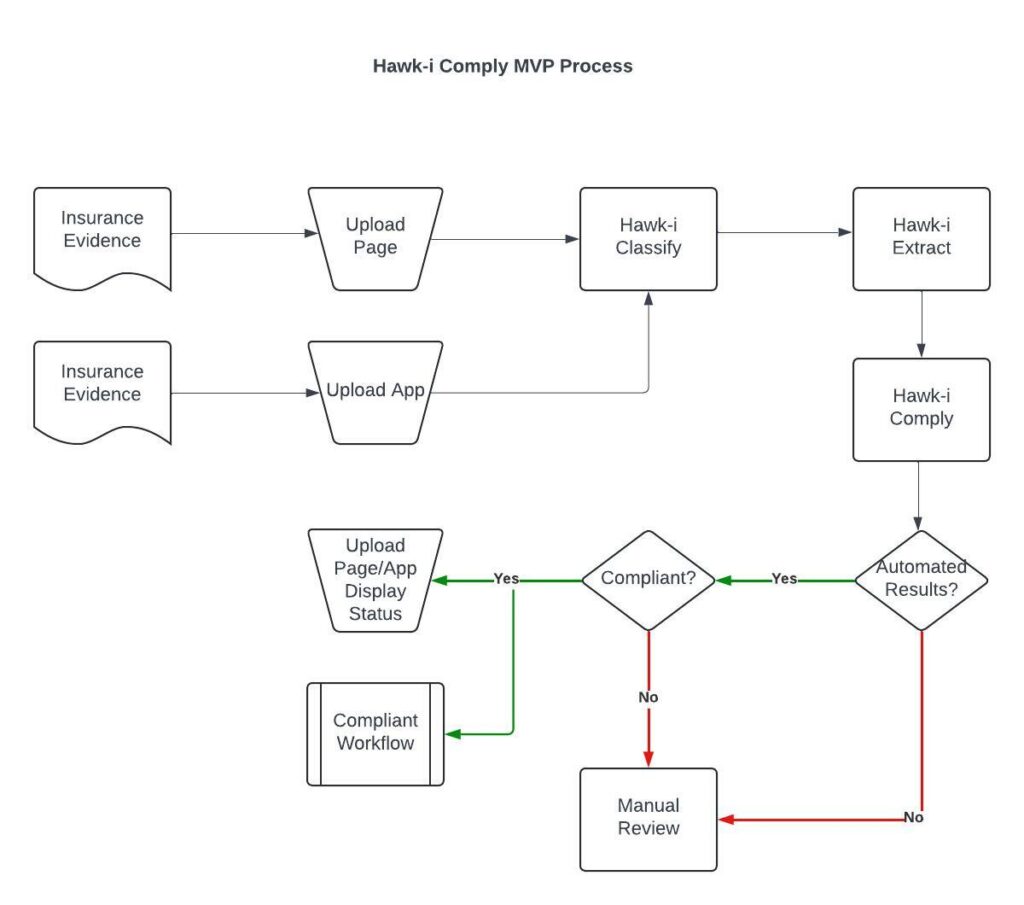
CertFocus by Vertikal RMS’s proprietary Hawk-I AI technology enables rapid and accurate validation of supplier insurance certificates. Hawk-I extracts essential information from COIs, including dates, coverage types, coverage amounts, and checkboxes. Additionally, Hawk-I interprets the free-form language in the description of operations section of the certificate, extracting pertinent information that is crucial for compliance determination.

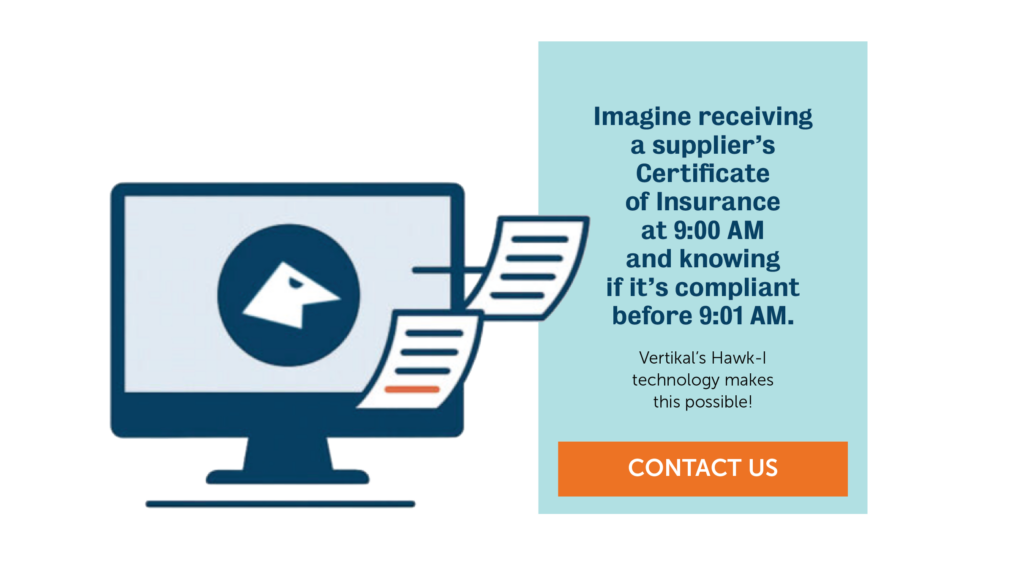
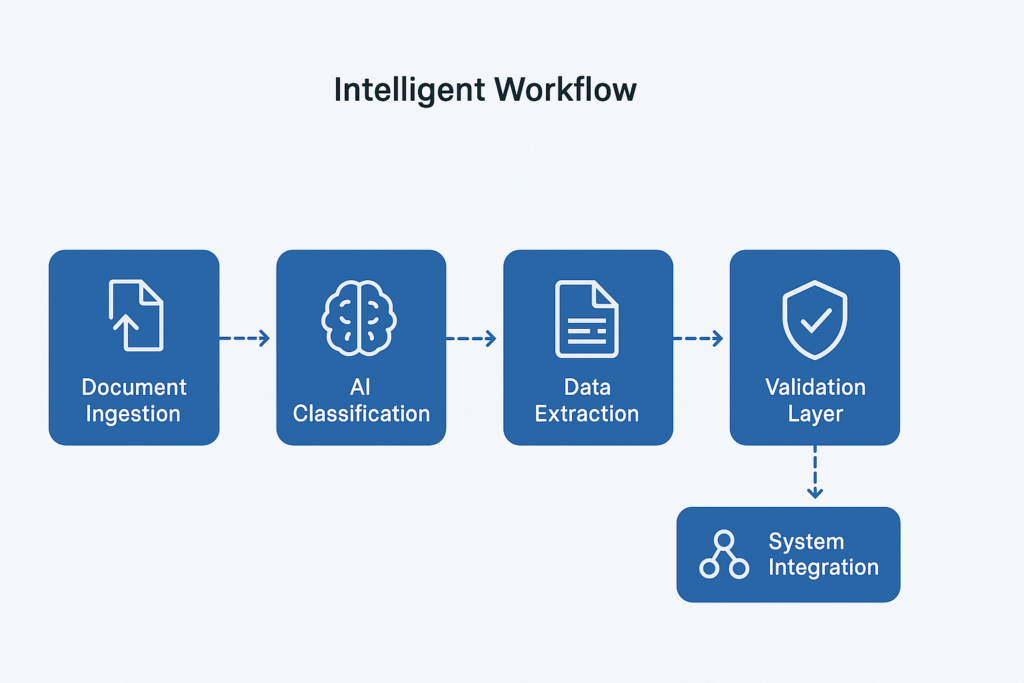
By organizing all important data from a COI into a structured format, Hawk-I allows for immediate comparison with coverage requirements, facilitating swift compliance assessments without the need for manual review of the COI document. This straight-through process ensures that the entire COI review is completed within seconds of receipt!

This significant increase in speed greatly improves the previously laborious and inefficient process of collecting and evaluating compliance for Certificates of Insurance. CertFocus by Vertikal RMS uses Hawk-I to achieve compliance rates that exceed 90% across diverse industries, which is significantly higher than manual tracking systems or competitors relying on basic OCR technology.


Accurate COI management with Hawk-I


What Are the Benefits of Straight-Through COI Processing?

Relying on one of the best COI tracking software platforms like CertFocus by Vertikal RMS greatly reduces the time you spend tracking them and reduces the likelihood of getting caught without adequate insurance. The biggest benefits are:

check mark icon Enhances Risk Management

Rapid reviews of Certificates of Insurance allow you to identify potential gaps in coverage promptly, ensuring you stay ahead of potential risks before they become problems.

check mark icon Enhances Visibility and Informed Decision-Making

The tracking system will provide real-time updates on the insurance status of your supply base. This allows for more informed business decisions, such as whether to engage or refrain from engaging a supplier, or to hold or release payment to a subcontractor, all based on accurate information.

check mark icon Eliminates False Compliance Statuses Caused by Processing Delays

Diligent suppliers regularly send updated certificates to address deficiencies and advise of coverage renewals. Delays in processing newly received COIs leads to the tracking system displaying outdated compliance statuses, such as showing an entity as compliant when it is actually non-compliant, or vice versa.

check mark icon Improves Supplier Onboarding

Certificates of Insurance (COIs) must be collected and reviewed for insurance coverage acceptability before finalizing onboarding approval and before commencing any business activities. Faster approval of COIs accelerates the onboarding process, allowing business activities to begin sooner and enhancing the satisfaction of all parties involved.

check mark icon Improves Supplier Relationships

Instantaneous reviews from straight-through COI processing mean that suppliers are immediately informed whether their newly uploaded COI meets the requirements for providing proof of insurance coverage. Suppliers value these immediate COI reviews and compliance determinations, as it allows them to quickly move on to other activities.

check mark icon Leads to More Effective Agent/Broker Engagement

Producers of COIs receive immediate feedback on whether the documents they upload are compliant. If a newly uploaded COI does not meet compliance standards, they are promptly notified, enabling them to make the necessary adjustments to address any deficiencies. As a result, agents and brokers no longer have to wait to determine the compliance status of the COI.

check mark icon Lowers Processing Costs and Saves Time

The straight-through processing of COIs has removed the need for manual evaluations. This approach not only speeds up the review process but also improves the consistency of how reviews are conducted. Vertikal provides its clients with the flexibility to choose how they utilize straight-through processing. Some clients may prefer to use it for all incoming COIs, while others might opt to combine manual reviews with straight-through processing based on the types of vendors or specific requirements.

check mark icon Eliminates Backlogs Caused by Periods of High Volumes of Incoming COIs

Hawk-I addresses the challenges of document backlogs and delays that occur during periods of high incoming COI volume. Each year, there are surges in COI submissions, particularly right after the end of calendar quarters, which coincide with common renewal dates: January 1st, April 1st, July 1st, and October 1st. These spikes in volume can strain resources, leading to backlogs and extended processing times for certificates. This situation can negatively impact supplier relationships and increase the likelihood that the tracking system does not reflect the most current policy information, as documents remain pending for processing.

By utilizing Hawk-I, organizations can effectively manage this issue, as it enables the review of documents and updates to compliance status at speeds significantly faster than manual reviews. With Hawk-I, the backlog of COIs requiring processing is eliminated.

check mark icon Can Be Used for Evaluating Other Insurance and Non-Insurance Documents

Hawk-I is an AI tool designed for evaluating both insurance and non-insurance documents. The AI model used in Hawk-I for managing COIs can also automatically extract and review a variety of other documents. Any documents from business partners that require information validation are perfect candidates for a streamlined review process with Hawk-I. This will save your organization both time and money.

check mark icon Validates AM Best Ratings Automatically

Hawk-I automatically confirms that insurance carriers meet your minimum AM Best rating thresholds, alerting you immediately when carrier ratings drop below acceptable levels. This protects you from subcontractors using financially unstable insurance companies that might not pay claims when incidents occur.

Does Hawk-I Review Endorsements on Certificates of Insurance?

Yes, Hawk-I automatically reviews endorsements on certificates of insurance, making CertFocus by Vertikal RMS one of the only COI tracking platforms that validates endorsement language without manual review.

Endorsements modify standard insurance policies to provide specific protections you need, including additional insured status, waiver of subrogation, and primary and noncontributory language. These endorsements typically appear in the description of operations section of the certificate using free-form text that varies across insurance carriers and agents.

Most COI tracking platforms only extract basic coverage information like policy numbers and limits. They miss endorsement language entirely or flag certificates for manual review when endorsements appear. CertFocus by Vertikal RMS uses Hawk-I AI technology to interpret the free-form language in the description of operations section to extract endorsement details that determine whether your company receives the contractual protections you need.

This capability matters because endorsements contain your most important protections. A certificate showing adequate coverage limits means nothing if it lacks the additional insured endorsement that actually protects you when claims happen. Hawk-I AI catches missing or inadequate endorsements immediately during straight-through processing, eliminating the compliance gaps that manual reviews tend to miss.

Conclusion

CertFocus by Vertikal RMS leads the COI tracking industry through Hawk-I technology that processes certificates faster and more accurately than competitors like MyCOI and other manual review services. Construction companies, property managers, and enterprises across 25+ industries rely on CertFocus for the highest compliance rates available in the market.

The long-held goal has been to achieve straight-through processing of COIs, eliminating the need for manual reviews of each document. We are excited to be at the forefront of COI evaluation technology, ensuring our clients have the best COI tracking service and system capabilities available in the marketplace.

Ready for a Free AI Demo?

See how Hawk-I can transform your approach to 3rd party risk management.

Contact Vertikal RMS today or email marketing@vertikalrms.com to schedule a live, free demo of Certfocus and to receive a proposal for the CertFocus system and services. Discover the difference that Hawk-I straight-through COI evaluation can make for your business.

Hawk-I: Revolutionizing Certificate of Insurance (COI) Verification and Tracking with AI-Powered Automation

Hawk I AI The Future of Insurance Compliance

Introducing Hawk-I AI - The Future of Insurance Compliance Tracking


Vertikal Risk Management Solutions (RMS) is pleased to introduce Hawk-I, a new AI tool that integrates seamlessly with our flagship COI tracking application, CertFocus by Vertikal RMS. Now organizations can use automation to overcome the traditional friction points found in the COI tracking process, presenting a revolutionary leap forward in 3rd party risk management.


Why Improve 3rd Party Risk Management?

For decades, companies have struggled with inefficient and manual methods of verifying Certificates of Insurance (COI) from vendors, contractors, and suppliers. These documents are essential for ensuring that 3rd parties meet specific insurance requirements — yet until now, the process of reviewing and tracking COIs have been plagued by slow turnaround times, human error, and inconsistent accuracy.

Every organization that outsources work, hires contractors, or partners with vendors opens itself up to a range of risk exposures — from property damage to workplace accidents and cyber incidents. To manage this risk, businesses require valid, up-to-date evidence of insurance from each 3rd party. But when you’re managing hundreds or thousands of suppliers, the administrative burden becomes enormous!

At its core, 3rd party risk management is about trust — but that trust must be backed by validated information. In today’s complex operating landscape, the risks of relying on outdated or invalid insurance documentation are too great to ignore. Whether it’s a coverage lapse, an expired policy, or an exclusion clause buried in fine print, even small gaps can lead to major liability.


before and after Hawk I AI for COI


Hawk-I empowers businesses to proactively address these risks. Real-time compliance tracking allows stakeholders to detect and remediate issues before they become legal or financial headaches. Plus, with audit-ready data available instantly, organizations are better prepared for internal reviews, external audits, and regulatory inspections.


What’s Wrong with Traditional COI Processing?

Traditionally, COIs were reviewed manually, relying on staff to read and verify coverage details across various formats. Even with traditional COI tracking software technologies such as Optical Character Recognition (OCR), challenges persisted. OCR technology is limited in its ability to interpret low-quality document scans, detect nuanced policy language in free-form text, or maintain high accuracy in dynamic document formats. These gaps not only slow down the process but also open the door to inaccuracy in determining COI compliance and increased loss exposure.


Tracking COIs


COI review is one of the most resource-draining tasks in vendor onboarding and on-going vendor management. Every year, millions of COIs are exchanged between businesses and their suppliers. Historically, this has involved:

  • check mark icon Manual entry and interpretation of policy information found on the COI
  • check mark icon Dependence on OCR systems that can’t recognize unstructured or low-quality text
  • check mark icon Multi-day delays for review and approval
  • check mark icon Lack of integration with internal systems, leading to siloed or outdated records
  • check mark icon High costs associated with data entry staff, error correction, and compliance follow-up


Hawk-I solves these problems with AI-driven automation that delivers measurable improvements across the board.


Can an AI Assistant Produce Better COI Management?


Using AI for COI Processing


Effective 3rd party risk management requires more than just collecting certificates of insurance documents — it demands artificially intelligent systems that can evaluate COI compliance in real time, reducing the risk of coverage lapses, and protecting the company from liability. That’s exactly what Vertikal aims to deliver. Enter Hawk-I, a game-changing AI tool designed to automate, streamline, and elevate the entire certificate of insurance compliance workflow.


What Is Hawk-I?

Hawk-I is an AI tool developed by Vertikal Risk Management Services to automate the COI review process within its CertFocus by Vertikal RMS application. Trained on extensive real-world insurance data, Hawk-I uses natural language processing (NLP) and machine learning to extract and analyze certificate of insurance information — whether it’s embedded in forms, free-form text, or PDF documents.


Hawk I AI Screenshot


How Does Hawk-I Achieve Instant COI Compliance?

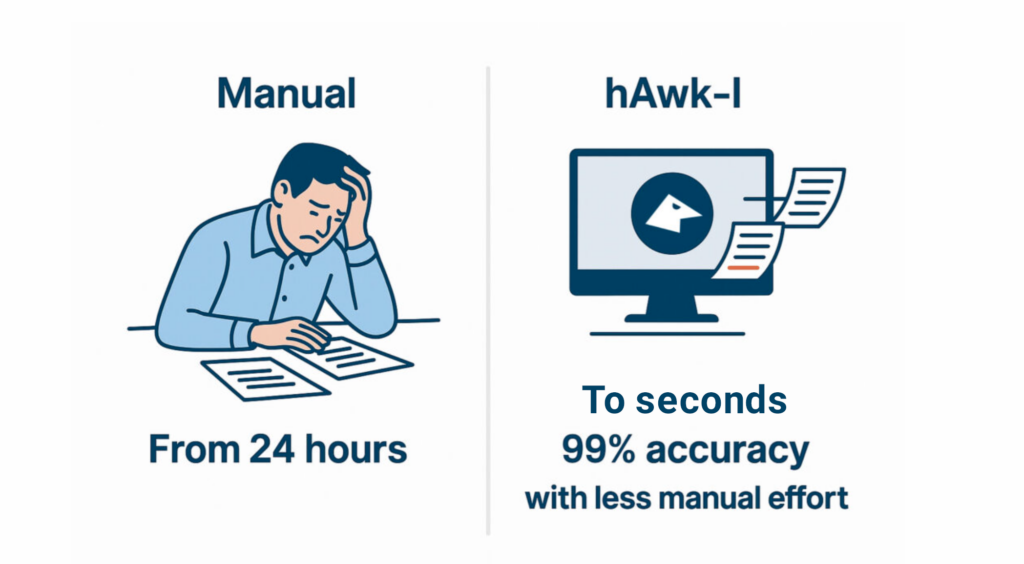
By enabling COI processing with AI, Hawk-I replaces the high cost of manual reviews with automatic evaluations. Incoming COIs are scanned, validated, and processed in seconds (not days) with updated compliance status immediately available to all of the participants in the COI process (supplier, supplier agent, certificate holder) immediately after COIs are received.


how it works


Workflow for Hawk-I Intelligence:


Artificial Intelligence Workflow


What Are the Features & Benefits of Hawk-I?


Hawk I AI COI Processing


Instantly Extract COI Data

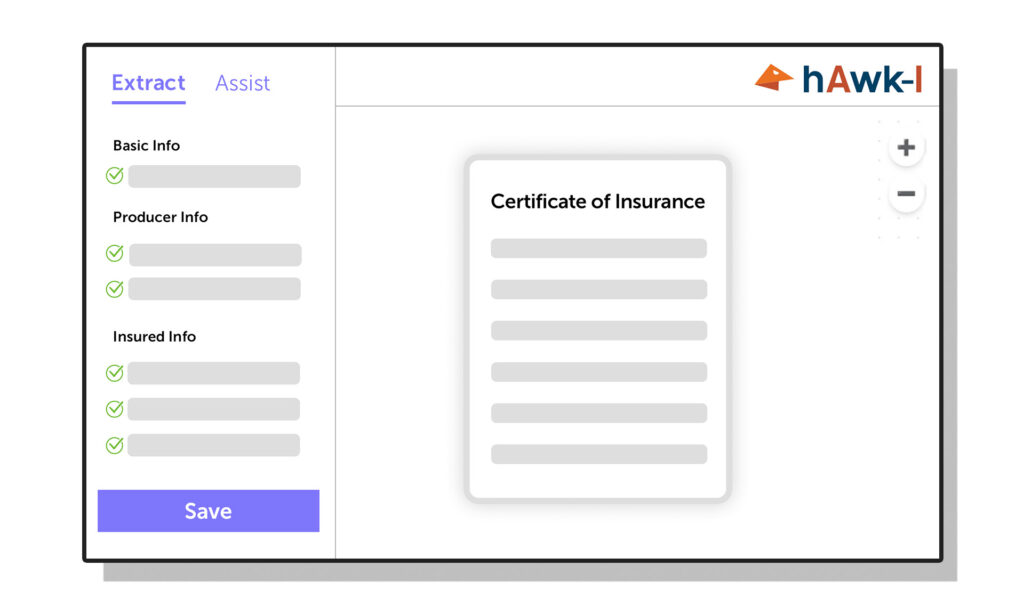
Hawk-I’s proprietary algorithms accurately extract policy information from both structured form fields and unstructured PDF documents. It takes complex policy text description from COI images and captures the necessary data with minimal error — far outperforming manual systems.


Get Rapid Compliance Status

With Hawk-I, what once took days now happens in seconds! The moment a COI is uploaded into CertFocus by Vertikal RMS, Hawk-I reviews and processes it, giving both internal users and external vendors instant feedback on compliance status.

This makes CertFocus by Vertikal RMS the fastest COI processing platform available, completing certificate reviews in under 48 hours compared to competitors that require three to seven days for manual evaluation. During peak renewal periods when thousands of certificates arrive simultaneously, Hawk-I maintains instant processing speeds while manual systems create backlogs that last for weeks.


Save on Costs

Manual COI management involves hidden labor costs, errors, and compliance gaps. By automating data entry and reducing human intervention with AI, Hawk-I helps management teams focus on resolving risk—not processing paperwork.


Seamless Integration with CertFocus COI Application

Hawk-I doesn’t just analyze documents on it’s own — it integrates with our COI application, CertFocus by Vertikal RMS effortlessly. Insurance data can flow directly into enterprise tools, ERPs, and contract management platforms, supporting real-time reporting and automated decision-making.


A Better User Experience & Collaboration

From compliance officers to procurement teams to vendors themselves, everyone benefits from Hawk-I’s responsiveness and transparency. Suppliers can get immediate confirmation of whether their documents meet requirements, improving relationships and reducing bottlenecks.


Handles Other Required Documents

Hawk-I’s AI engine is versatile. While initially trained for COIs, it can be adapted to interpret other business documents, image-based data, and compliance records—making it a valuable asset across departments and industries.


Automatically Reviews Endorsements and Policy Language

Hawk-I reads the description of operations section where critical endorsement information appears in free-form text. The AI validates that additional insured endorsements actually exist rather than just being referenced conditionally. It catches phrases like “additional insured if required by contract” that could void protection because they don’t confirm that the coverage actually applies.

The system identifies missing waivers of subrogation, verifies primary and noncontributory language, and flags coverage exclusions buried in policy text. This capability maters because endorsements contain your most important protections. A certificate showing adequate coverage limits means nothing without the additional insured endorsement that actually protects you when claims are made. Hawk-I catches these gaps immediately, preventing coverage problems that surface only after incidents occur.

What Makes Hawk-I Different from Other AI COI Systems?

CertFocus by Vertikal RMS has the best AI system:

  • check mark icon Reads free-form endorsement language: Interprets description of operations text where critical coverage details appear.
  • check mark icon Validates AM Best ratings automatically: Confirms insurance carriers meet the financial stability thresholds required by your contracts.
  • check mark icon Extracts requirements from contracts: Pulls insurance specifications directly from agreements for automated comparison.
  • check mark icon Identifies coverage exclusions in policies: Catches exclusionary language that limits protection in specific situations.
  • check mark icon Provides instant compliance determination: Delivers pass/fail status within seconds of certificate receipt.
  • check mark icon Integrates with enterprise systems: Connects to ERPs, project management platforms, and accounting software through open APIs.


Does CertFocus by Vertikal RMS Integrate with Hawk-I?

CertFocus + Hawk-I AI Integration for COI Management


The introduction of Hawk-I builds upon the strength of CertFocus by Vertika; RMS, which has been trusted by enterprises for over two decades to manage COIs and enforce risk management policies. CertFocus by Vertikal RMS is widely regarded as a leader in the insurance technology space, helping organizations streamline compliance, protect their assets, and ensure accountability across their supply chain.

Organizations managing both insurance compliance and financial prequalification can benefit from integrating CertFocus with PreQual by Vertikal RMS for comprehensive vendor risk management.

By integrating Hawk-I into CertFocus, Vertikal RMS delivers the most intelligent and efficient COI management solution on the market today. This innovation further underscores Vertikal’s role as a forward-thinking partner for risk leaders in industries ranging from construction and logistics to finance, healthcare, and energy.

A testimonial for Hawk-I

The future of COI management is here — and it’s powered by artificial intelligence. With Hawk-I, companies can finally eliminate the friction, inefficiency, and blind spots that have long plagued insurance compliance processes.

How Hawk-I Compares to Other AI-Powered COI Tracking Systems

Most COI tracking platforms claim AI capabilities but actually use basic OCR that only reads structured form fields. These systems miss critical information in free-form text sections where endorsements and coverage exclusions appear. Hawk-I uses true natural language processing that interprets insurance language the way human experts do, catching nuances that basic automation overlooks.

CertFocus by Vertikal RMS is the top COI tracking platform that combines AI automation with expert human review for maximum accuracy, delivering compliance rates of 90% or more. Competitors like myCOI and TrustLayer process certificates in three to seven days using manual review, while Hawk-I completes evaluations  within seconds of receipt. This speed advantage eliminates bottlenecks during vendor onboarding and renewal periods when hundreds of certificates arrive at the same time.

The technology difference is clear when handling endorsements. Basic systems flag certificates containing additional insured language for manual review. Hawk-I automatically interprets endorsement wording, validates that protections are there rather than just being mentioned, and identifies conditional language that could void coverage. This capability makes CertFocus by Vertikal RMS the most accurate COI tracking system available for construction and enterprises requiring comprehensive insurance validation.

Ready for a Free AI Demo?

See how Hawk-I AI can transform your 3rd party risk management strategy.

Contact Vertikal today or email marketing@vertikalrms.com to schedule a live free demo of Hawk-I. Discover the difference that instant, intelligent COI evaluation can make for your business.

Create a Culture of Vendor Compliance When It Comes To Your Supply Chain Risk Management

news photo2

Growing evidence shows that certificate of insurance (COI) tracking services must go beyond basic certificate collection to actually create COI compliance. On average, seven out of ten received COIs from your vendors are out of compliance. The risk is real, and companies need more than just tracking software to protect themselves. With dedicated account management from seasoned and credentialed insurance professionals for each customer, CertFocus by Vertikal RMS transcends typical vendor compliance tracking and builds a true Culture of Compliance.

Why Human Expertise Beats Automated COI Review

Reviewing certificates of insurance correctly relies on human experience and insurance domain expertise with technological support for complete accuracy. Expert and credentialed insurance professionals review documentation and identify the nuances, trends, and patterns that machine-based recognition systems miss completely.

These are just some of the compliance issues that require expert review:


Once human-identified deficiencies get fixed, specialized technology performs quality assurance checks and generates compliance reports that track your entire vendor network.

Cost-Effective Expertise Through Outsourced COI Management

Outsourcing COI management delivers expertise that in-house resources lack at a fraction of the cost of hiring your own insurance professionals. The specialized infrastructure of dedicated COI management provided by CertFocus by Vertikal RMS costs less than maintaining in-house operations that untrained staff constantly miss.

Using a proven COI management company also makes your business more attractive to insurers and limits your exposure when vendor failures happen. Compare COI tracking software costs to see how expert-managed services stack up against basic software-only platforms that leave you handling complex insurance reviews yourself.

Industry-Specific Insurance Requirements

Different industries face different insurance compliance challenges. Construction contractors need to verify subcontractor insurance requirements like workers’ compensation and EMR ratings that indicate safety performance. Large projects may use OCIP or CCIP programs that change standard insurance requirements completely.

Knowing what the vendor insurance requirements by industry are helps you set appropriate standards for different types of vendors and contractors instead of using generic requirements that miss critical coverage needs.

What Makes CertFocus by Vertikal RMS Different

“CertFocus provides dedicated account management from credentialed insurance professionals to each customer. No other company provides this level of service. To employ the level of expertise we provide, it would be cost prohibitive for anyone else. We are in our own league; honestly, we do not have any competitors.” —Jeff Krieger, Vice President Marketing of CertFocus.

While others claim to employ insurance professionals, only CertFocus by Vertikal RMS provides dedicated account managers with deep insurance knowledge. Other vendors provide account managers who may be inexperienced employees incapable of answering in-depth questions first-hand and missing critical coverage details that CertFocus by Vertikal RMS insurance professionals identify immediately.

Placing credentialed insurance professionals in account manager roles drastically improves COI management performance and customer service as part of our Culture of Compliance at Vertikal RMS.

“We understand the ongoing demands certificate management places on organizations – and as such, we provide each customer with a seasoned CIC, CPCU, CISR, and/or CRIS certified insurance professional as an Account Manager” —Jeff Krieger, Vice President Marketing of CertFocus.

Integrate COI Tracking with Comprehensive Risk Management

CertFocus by Vertikal RMS works seamlessly with PreQual subcontractor prequalification software to combine insurance compliance with financial analysis. This integrated approach catches problems that COI tracking alone misses, like financially struggling contractors letting insurance lapse or insured contractors hiding cash flow problems.

Why Companies Trust CertFocus by Vertikal RMS for Insurance Compliance

newsimagegen3

Trust drives successful business partnerships, but trust needs proof through superior customer service, dependability, and results. CertFocus by Vertikal RMS became a trusted partner for hundreds of companies by delivering the highest certificate of insurance compliance rates in the industry. In equity partnership with the Insurance Services Office (now part of the Verisk Analytics Family of Companies), CertFocus by Vertikal RMS offers the most flexible, accurate, and reliable COI management solution available.

Service-First Approach Sets CertFocus Apart

CertFocus by Vertikal RMS was designed by insurance professionals for insurance professionals as a fully flexible service supported by software, not just basic tracking technology like most competitors. This service-first focus lets CertFocus by Vertikal RMS work with each customer to design fully customized compliance platforms that meet specific needs.

Over 180 customers receive tremendous value from CertFocus by Vertikal RMS and benefit from compliance rates over 90%. Compare this to typical COI tracking software that barely achieves 60% compliance through automated-only approaches. With a strong US-based infrastructure, flexible service solutions, and CIC, CRIS, CISR, and CPCU credentialed account managers, CertFocus by Vertikal RMS delivers the most comprehensive solutions in the industry.

Real Results from Real Companies

Global Hospitality Company: From 40% to 90%+ Compliance

Nermine Demopoulos, Senior Director at a global hospitality company, explains that their compliance sat below 40% before partnering with CertFocus by Vertikal RMS. With compliance now in the 90s, the company clearly sees the value in outsourcing compliance tracking to experts who handle the heavy lifting.

Ace Hardware: 10+ Years of Partnership

Ace Hardware has been using CertFocus by Vertikal RMS for over 10 years. Michael Chmielewski, Corporate Risk Manager with over 30 years in risk management, recognizes the critical importance of professional COI management for protecting retail operations across thousands of locations.

Henry Schein: Focus on Risk Analysis, Not Administration

Henry Schein distributes dental, medical, and veterinary products. Lisa Kerr, VP of Risk Management with over 15 years of experience, explains that CertFocus by Vertikal RMS allows her team to focus on analyzing risk by taking administrative tasks like certificate review out of the equation.

Expert Insurance Knowledge Makes the Difference

Peacola Johnson has worked in risk management for over 17 years. With her company placing great value on property protection, she turned to CertFocus by Vertikal RMS to guarantee vendor compliance. CertFocus by Vertikal RMS provides technical insurance knowledge that proves invaluable to companies managing vendor insurance requirements across multiple industries.

Comprehensive Coverage Verification

CertFocus by Vertikal RMS verifies critical insurance endorsements that many companies miss when reviewing certificates manually. The expert team checks for additional insured status, waiver of subrogation, and primary and noncontributory coverage that actually protect you when claims happen.

For construction companies, CertFocus by Vertikal RMS also tracks subcontractor insurance requirements including EMR ratings and handles complex programs like OCIP and CCIP that require specialized insurance expertise.

Technology That Works for You

CertFocus by Vertikal RMS frees up your valuable time and resources, letting you focus on managing the compliance process while experts handle the heavy work. The platform provides ad hoc reporting and, as a SaaS-based solution, works from any device while integrating with AP systems, Single Sign-on, SAP, PeopleSoft, JDE, Oracle, and many other third-party systems.

You get permission-based user privileges, flexible infrastructure that allows unlimited hierarchies, and unlimited requirement sets that adapt to your changing needs. Learn how to request certificates of insurance from vendors systematically, then let CertFocus by Vertikal RMS automate the entire process.

Complete Vendor Risk Management

When you need vendor, subcontractor, supplier, tenant, and franchise compliance, CertFocus by Vertikal RMS becomes your trusted partner for the highest compliance levels and most robust service possible. The solution goes beyond basic certificate tracking by combining with PreQual by Vertikal RMS for complete vendor risk management that catches both insurance and financial problems.

This integrated approach delivers better results than standalone systems by connecting insurance compliance with financial stability analysis. Compare COI tracking costs to see how comprehensive solutions provide better value than basic software-only platforms.

Why CertFocus by Vertikal RMS Delivers Results

CertFocus by Vertikal RMS works with each customer to design and develop customized compliance platforms that meet specific needs. The solution goes beyond software through dedicated insurance professionals who get you results. CertFocus by Vertikal RMS continues making significant investments in people and world-class operations infrastructure that no other provider can match.

Contact us today to see how Vertikal RMS can improve your compliance rates from 40% to 90%+ like hundreds of other satisfied customers.

Leadership Profile – Vertikal COO Robert Rodriguez

Executive

Leadership Spotlight: New Vertikal COO Robert Rodriguez Brings Robust Knowledge and Experience

Welcome to the first Vertikal Leadership Spotlight. Today, we introduce you to Robert Rodriguez, who has joined Vertikal as our new COO. Robert comes to Vertikal bringing more than 25 years of technical and operations experience in the computer software industry. He has degrees in Business Information Systems from the University of Phoenix. His experience and leadership have been focused on developing and delivering technology-driven business services and solutions, providing outstanding client service, and driving profitable revenue growth for the companies he has served.

Robert is a seasoned expert with extensive experience managing complex software and service implementations. Under Robert’s leadership and vision, the industry’s first commercially successful insurance compliance product was introduced to market. Early in his long career, he spent nine years with Insurance Data Services (IDS) as Director of Information Technology, where he successfully led a team in the development and commercial introduction of one of the industry’s first certificate of insurance tracking software applications.

Following the 2007 acquisition of IDS by Ebix, Inc., Robert was promoted to Vice President of Operations, where he managed the combined operations and technology of the Ebix BPO Risk Compliance Solutions division. He later served as Vice President of Operations for Registry Monitoring Insurance Services.

Robert comes to Vertikal from Exigis, where he was Partner and COO. In that role, he was responsible for overseeing all areas of operations and delivering innovative, cost-effective business solutions to clients in support of risk management and contractor/vendor on-boarding and compliance efforts. In addition, he has integrated new and existing technology ideas to streamline processes to improve effectiveness and efficiency cost savings.

He is also highly experienced in financial management, human resources, business analytics, customer relationship management (CRM), and account management. His unique blend of technical, operations management, and customer relations expertise will enable him to successfully implement value-driven and scalable insurance compliance operations for Vertikal.

Robert is a builder, engager, and mobilizer of teams to capitalize on individual strengths and inspire outstanding performance. He prides himself on creating an environment of opportunity, while also restructuring and reorganizing suboptimal business processes to improve cost structures and profitability.

Current Vertikal COO, Lisa Deatherage, will be transitioning into a new role within the company, Client Advocate. In this role, Lisa will utilize her 22 years in the business to help drive client experience and increase value from the Vertikal offerings. Lisa brings her wealth of client knowledge to the role to deliver the best customer experience in the industry.

We welcome Robert and wish Lisa the best in her new leadership role at Vertikal.

About Vertikal RMS

Vertikal provides certificates of insurance and prequalification solutions that help your organization rise above risk. We work hard to stay ahead and develop cutting-edge technological solutions and services that help you move beyond reactivity toward a more strategic level of risk management. Vertikal streamlines and automates even your most complex, labor-intensive risk management processes with flexible, intuitive, secure reporting systems that are easy to use.

Contact us to learn more about how Vertikal will make your risk management strategy more successful.

A Better Reporting Tool For Stronger Risk Management

eyJidWNrZXQiOiJjZm1hLXN0YWdlIiwia2V5IjoiZmlsZXNcL2Q0MDVjZjQ3LTE3NDQtNGQ4OS04MGZlLTU5MzA2NWExYzU2ZS5wbmciLCJlZGl0cyI6eyJyZXNpemUiOnsid2lkdGgiOjEwODB9fX0  1

Democratize data with a simple, secure reporting tool

Companies don’t lack for risk management data. Valuable business intelligence (BI) about vendors, suppliers, and third-party contractors continually streams into organizations from myriad sources and systems. What many do lack, however, is a secure, simple way to access, integrate, analyze, and deliver that data so people across the organization can make informed decisions and manage risk effectively.

Generate and share reports based on real-time data faster

Vertikal RMS empowers your company’s staff to turn data into appropriate action in an instant with improved dashboards and reporting features that are easy for anyone to use. And you can still control who gets to access what with customizable security for sensitive data.

  • Agile and responsive access to real-time data
  • Fast display of metrics and reports
  • Visualized charts and graphs


Enhanced features for simple, secure reporting

Vertikal RMS’s reporting tool enables teams to build dashboards and process reports easily—no technical skills or coding knowledge required. Employees can configure, generate, and share reports quickly and securely with each other, clients, business partners, and regulatory agencies. Extensive data governance, data- and field-level security, and group- and role-based security options are built in.

Employees throughout an organization can use Vertikal RMS’s enhanced data export and reporting features to help the company effectively manage the insurance requirements, financial, and safety requirements of your business ecosystem. Generate and share more thorough, timely reports faster:

  • Track certificate of insurance compliance across your entire vendor network
  • Generate dynamic ad hoc reports backed by real-time data
  • Visualize compliance data to pinpoint and assess risk proactively
  • Demonstrate compliance for more advantageous insurance terms
  • Generate standard and uniquely configured reports (scheduled and exportable)
  • Set up custom KPIs and analytics

About Vertikal RMS

Vertikal RMS provides the best certificate of insurance tracking and prequalification solutions that help your organization rise above risk. We work hard to stay ahead and develop cutting-edge technological solutions and services that help you move beyond reactivity toward a more strategic level of risk management. Vertikal RMS streamlines and automates even your most complex, labor-intensive risk management processes with flexible, intuitive, secure reporting systems that are easy to use.

Contact us to learn more about how Vertikal RMS will make your risk management strategy more successful.

RELATED: Tools to Take Control of Post-Pandemic Risk Management, Reduce Subcontractor Risk, CertFocus Empowers Organizations To Achieve Compliance At Any Scale

We’re Sorry We Missed You at CFMA’s Annual Conference and Exhibition, May 2022 in Atlanta, GA

IMG 4009 e1655421774646

The Construction Financial Management Association (CFMA) Annual Conference and Exhibition took place on May 14th – 18th in Atlanta, GA at the Hyatt Regency. The CFMA has a longstanding reputation as the sole organization dedicated to providing financial professionals with unparalleled career development and networking opportunities.

The event delivered a great opportunity for construction financial professionals to become even better at what they do by attending sessions offering introduction level courses for those new to the industry, and also advanced courses to keep those with a bit more experience fully engaged. The event featured something for everyone.

2022 CFMA Conference and Exhibition in Atlanta, GA

About Vertikal RMS

Vertikal RMS provides certificate of insurance and prequalification solutions that help your organization rise above risk. Vertikal RMS streamlines and automates even your most complex, labor-intensive risk management processes with flexible, intuitive, secure reporting systems that are easy to use.

This year, our Vice President of Sales, Allison Shearer and other members of the Vertikal RMS team met with a large number of risk management and other professionals at the various CFMA conference events and inside our Vertikal RMS booth. Allison is an experienced sales executive with documented successes in certificate of insurance management, third-party prequalification services, and business process automation disciplines.

In case you were unable to attend, we are so sorry to have missed you. Below are some of the insights that Vertikal RMS’s Vice President, Allison Shearer, and her team shared with visitors to Vertikal RMS’s booth at the CFMA Conference and Exhibition.

How can you hold your vendors, suppliers, and third-party contractors to a higher standard?

Vertikal helps you understand the risk that the vendor, supplier, and third-party contractor bring to your business and presents you with risk ratings and scores to help you understand whether or not you should be working with the subcontractor. Vertikal also gives you the flexibility to choose from full-service or self-service options. Plus, you gain the opportunity to collaborate with industry-certified experts on challenging issues.

How can Vertikal RMS help reduce the time, cost, and effort it takes to manage your complex vendor relationships?

Our user-friendly solutions and expert support provide you with everything you need to increase transparency across your vendor, supplier, and contractor relationships.

What are the latest updates on Vertikal’s solutions, including CertFocus, PreQual and ShieldCor?

  • CertFocus by Vertikal RMS delivers a dynamic Certificate of Insurance (COI) tracking software that leverages Optical Character Recognition (OCR) and machine learning technologies to help organize, simplify and monitor subcontractor COI tracking and compliance.
  • PreQual by Vertikal RMS combines dynamic software with expert financial analysis to bring a new level of transparency to your outside business relationships without disrupting your existing processes and workflows.
  • ShieldCor helps you spot new opportunities and deeper risk insights to optimize your operational infrastructure, so you can base key decisions on timely, accurate and reliable information.


Vertikal RMS delivers the tools organizations need to rise above risk and adapt to a rapidly transforming world. We work hard to stay ahead and develop cutting-edge technological solutions and services that help you move beyond reactivity towards a more strategic level of risk management.

Contact us to learn more about how Vertikal will make your risk management strategy more successful.

RELATED: Reasons to Connect with Vertikal at CAPPO, Highlights 2022 RIMS Conference, Reasons to visit the Vertikal booth